Somewhere in the last year, "personal AI agent" stopped being a category in a pitch deck and became a thing normal people are told they should want. In 2026 it is not one product but a whole shelf of them, each promising the same thing with different branding: an assistant that knows you, that works while you sleep, that handles your email and your calendar and — soon, they all say, in the next update — the boring parts of your life.
The pitch is seductive because it is close to something real. An agent that actually knows you is genuinely more useful than one that does not. That is not marketing; it is how context works. The question is what that usefulness is built on, and who it ultimately serves.
This post is not another "big tech is evil" list. Every product below solves a real problem for real people. But every one of them also sits on the same unspoken architecture, and it is worth understanding that architecture before you hand it the contents of your life.
First, what a personal agent actually is
The word has been stretched until it barely means anything, so a short taxonomy helps.
- A chatbot answers what you ask, then forgets. No memory, no initiative.
- A copilot assists inside a specific context — an editor, a spreadsheet — and disappears when you leave.
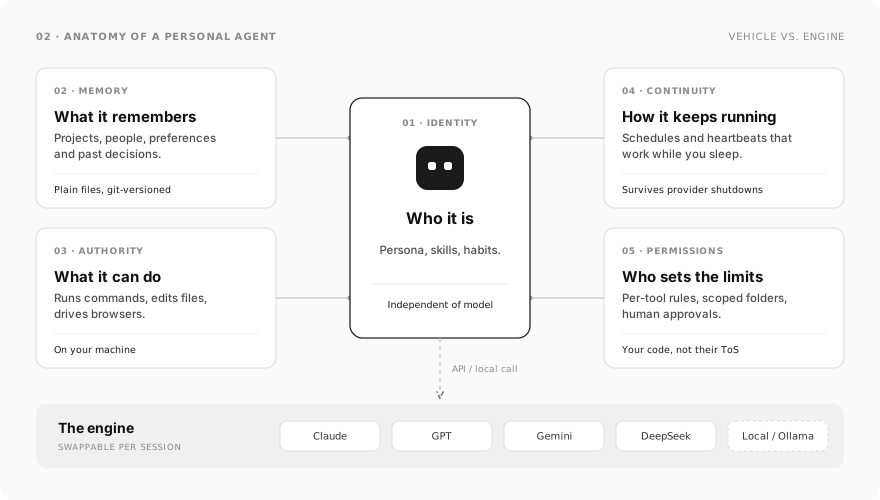
- An agent has memory (it remembers), authority (it acts — runs tools, sends things, changes state), and continuity (it keeps running without you standing over it).
- A personal agent is the agent aimed at you rather than at a business workflow: your inbox, your calendar, your files, your life. It is the difference between a tool you point at a task and a system you point at your week.
The defining property is not intelligence. It is persistence plus authority. An agent that cannot act is a chatbot with better recall. An agent that cannot remember is a script. The entire 2026 crop is betting that the combination — persistent and trusted to act — is the next platform.
The 2026 lineup
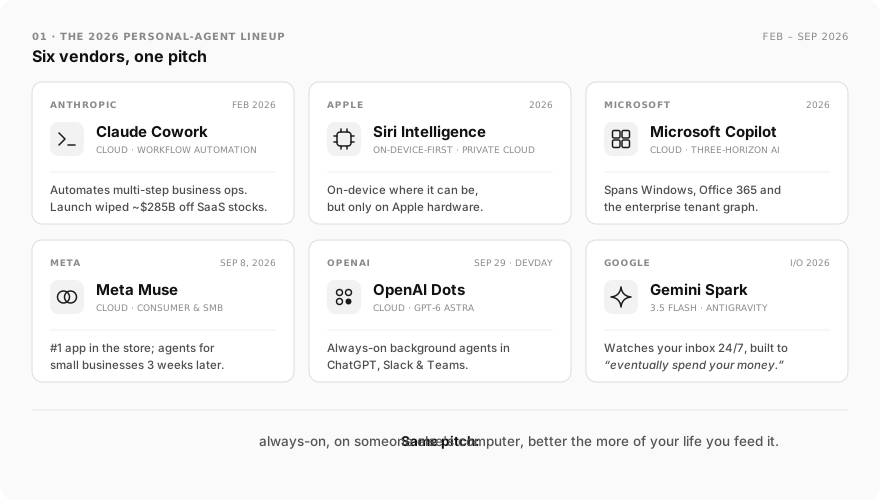
Here is who is selling you an agent this year, in rough order of when they showed up.
| Vendor | Product | Announced | What it runs on | The pitch |
|---|---|---|---|---|
| Anthropic | Claude Cowork | Feb 2026 | Cloud | Automates business workflows; the launch wiped roughly $285B off SaaS, IT, and legal market caps |
| Apple | Siri (Apple Intelligence) | 2026 | On-device-first | The private upgrade: your iPhone does it locally |
| Microsoft | Copilot | 2026 | Cloud | A "three-horizon AI architecture" rebuilt across Windows and Microsoft 365 |
| Meta | Muse | Sep 8, 2026 | Cloud | The most-downloaded app on arrival; performs tasks on your behalf and expanded to small-business agents within weeks |
| OpenAI | Dots | Sep 29, 2026 (DevDay) | Cloud (GPT-6 Astra) | Always-on personal agents with avatars, working across ChatGPT, Slack, and Teams |
| Gemini Spark | I/O 2026 | Cloud (Gemini 3.5 Flash + Antigravity) | A 24/7 agent that drafts email, watches your inbox, files things, pulls PDF data into Sheets — and, they say, will eventually spend your money |
Two patterns jump out. First, the timeline is accelerating: what the enterprise world took a couple of years to adopt, the personal-agent market compressed into about nine months. Second, the direction of every pitch is identical. The more of your data the agent can touch, the more "useful" it is described as being. That is the load-bearing fact, and every vendor says it like it is a feature rather than a dependency.
"Your agent" — a short translation guide
Each word in the marketing does real work. It is worth knowing what it is doing.
| You hear | Which means | What it does not say |
|---|---|---|
| "Your agent" | The account remembers you, in the vendor's database | You do not own the thing that remembers |
| "Memory" | A vector store on their servers, tuned to serve you better | Readable, portable, editable? No such claim is made |
| "Works for you" | Executes inside their sandbox, through their integrations | Whose rules define the limits? Their terms of service |
| "Private" | Encrypted at rest and in transit, with the operator able to read it as needed | "Private from other users" is not the same as "private from the operator" |
| "On-device" (Apple) | Inference runs locally on your hardware | The memory and identity still sync back into the account by default |
None of this is a lie. That is the tricky part. "Private" and "memory" and "works for you" are all true in the sense the vendor means them. The misdirection is in what the sentences leave out — specifically, who can read, move, edit, and survive the thing that knows you.
The real question: integration versus sovereignty
Every honest framing of this market keeps coming back to the same fork:
Are you willing to integrate all of your data more tightly into one company — or do you keep it for yourself?
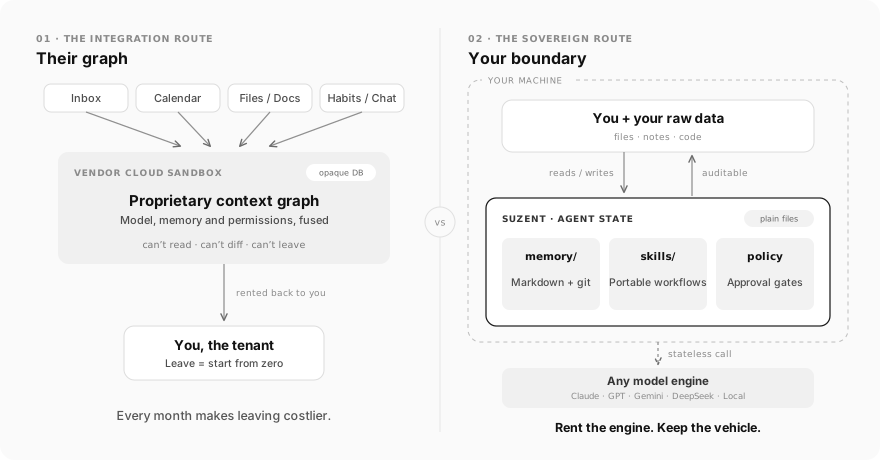
This is not abstract. Everything the agent does well — deduplicating your inbox, anticipating your schedule, filing your receipts — is powered by integration: the more of your life flows into one graph, the smarter the agent becomes about you. Integration is genuinely what makes these products feel magical. That is the honest case for the big-vendor agent, and it is a good one.
The honest case for the other side is that integration and ownership sit on the same axis, and they point in opposite directions. Every degree you deepen the integration, you deepen your dependence on whoever holds the graph. The agent that knows you best is, by construction, the one you can least afford to lose — and the one with the most complete picture of you.
You cannot optimize for both at full throttle. You can have a maximally helpful agent, or a maximally yours agent, and you have to choose how far to lean. What sovereignty offers is not more convenience — it is the option to say no, without having to start over.
There is a sane middle path
This does not have to be a clean either/or, and pretending otherwise is its own kind of dishonesty. The useful distinction is between the engine and the vehicle.
- The engine is the model — the intelligence. That can be rented. Frontier models are genuinely, measurably better at many things, and there is no shame in using them.
- The vehicle is your agent — its memory, its skills, the rules of what it may do, its identity, where it lives. That is what should be yours.
A sovereign agent that calls GPT, Claude, or Gemini through an API keeps cutting-edge capability while holding memory, permissions, and identity on your side of the line. You rent the engine; you own the vehicle. That configuration is what most people actually want, and it is what Suzent is built to be: memory as files you own, any model you choose, and explicit permission rules with human approval gates.
Four questions to ask before you hand one over
Whatever you pick, these cut through the copy. If you cannot answer them, you do not yet know what you are buying.
- Can I read all of its memory — in a plain format I can open? Not a settings preview. The whole thing.
- Can I edit or delete what it believes about me? Or is my only recourse telling it nicely and hoping the correction sticks?
- Can I disable, approve, and audit what it is allowed to do? Or is "what it may do" a sentence in a terms-of-service I accepted once?
- If the vendor disappears, shuts down, or triples the price — does my agent survive? Or was the agent actually a rental dressed as a companion?
A personal agent is going to become the most intimate software you own — more so than your email, your browser, maybe your phone. It will know what you decided, what you abandoned, what you are afraid to admit you keep putting off. The only question that ever really mattered, and the one this post keeps circling, is the one you should sit with before you click past the next changelog:
Are you willing to integrate it — all of it, more tightly every year — into one company? Or do you keep it for yourself?
Quickstart · Source (Apache-2.0)